
How to Create a Mediterranean-Inspired Backyard in Southern California
There is a reason the Mediterranean aesthetic resonates so deeply with people here in Southern California. Our climate is nearly identical to the coastal regions of Spain, Italy, and Greece. Warm, dry summers. Mild winters.
Long golden afternoons that beg you to be outside. When a client comes to me and says they want their backyard to feel like a villa in Tuscany or a courtyard in Seville, I understand exactly what they mean, and I know our landscape can deliver it in a way few other places in the world can match.
Over the years I have designed several Mediterranean-inspired gardens across Pasadena, La Canada, San Marino, and the surrounding foothills. What I have learned is that this style is not about importing Italy. It is about understanding the underlying principles of Mediterranean design and expressing them through plants, materials, and details that are genuine to where we live.
Done well, the result feels inevitable, like the garden could not exist anywhere else.
Here is how I think about it.
Start with the Architecture
Mediterranean garden design does not happen in isolation. It is always in conversation with the house. The architecture sets the tone, and the garden follows.
In our area, we are lucky to have a wealth of homes that already speak this language. Spanish Revival and Mission-style homes, which are beautifully abundant across San Marino, La Canada, and the historic neighborhoods of Pasadena, come with built-in cues: red tile roofs, stucco walls, arched doorways, wrought iron details. Those elements are your starting point. The garden should feel like a natural extension of what the house is already doing.
Even if your home does not have Spanish or Mediterranean roots, the style can be achieved through the right material choices. The key is to select finishes that feel warm, textural, and grounded: natural stone, aged terra cotta, rough-hewn wood, hand-forged metal. These are the materials that make a Mediterranean garden feel authentic rather than themed.

In our La Canada Spanish Revival project, we let the home's architecture guide every decision. The formal garden features classic terra cotta planters at each corner, a sculptural ceramic fountain at the center, and hand-laid flagstone pathways that wind through the property.
Spanish tile work, framed by the graceful branches of mature citrus trees, adds the kind of rich architectural detail that feels as old as the house itself. The result is a garden that looks as though it has always been there.
Design for Outdoor Living, Not Just Outdoor Looking
One of the things I love most about Mediterranean garden culture is that it is genuinely designed for living. The gardens of Provence and the courtyards of Andalusia were not meant to be admired from inside. They were meant to be inhabited. Meals eaten, conversations had, afternoons passed in the shade of an olive tree.
This is the design principle I carry into every Mediterranean-inspired project. The garden should have rooms, places with a defined sense of enclosure and purpose. A dining terrace. An intimate seating alcove. A shaded retreat. A path that draws you through the garden from one experience to the next.

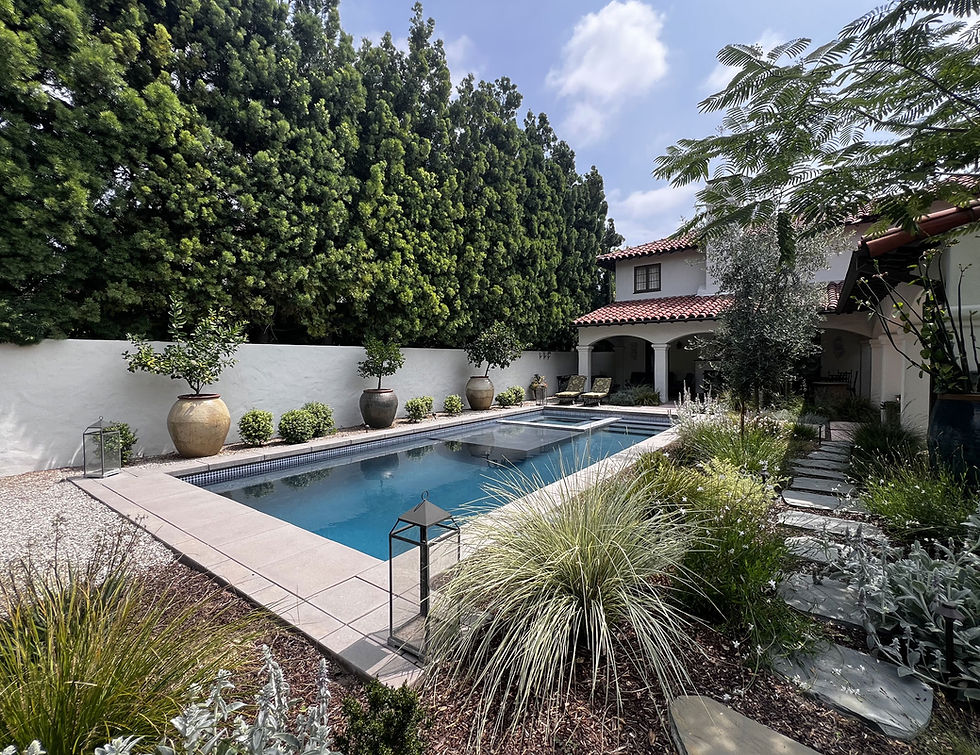
In our San Marino Mediterranean pool project, we created multiple zones within a single estate property. The pool and spa form the centerpiece, with natural stone coping and a generous hardscape that accommodates both intimate gatherings and larger entertaining.
Stepping stone pathways wind through layered plantings, connecting the pool area to secluded seating alcoves that offer a quieter alternative to the main terrace. Every part of the garden has a reason to be visited.
That layering of experience is something I think about in every design. You want arrival, journey, and destination, not just a flat expanse of hardscape leading to a single focal point.
Choose the Right Plants
The plant palette is where a Mediterranean garden finds its soul. And the wonderful news for those of us designing in Southern California is that the plants that define this aesthetic are almost identical to the ones that thrive in our climate without much water.
This is not a coincidence. Mediterranean plants evolved in the same conditions we have here: long dry summers, well-drained soils, and intense sun. They are built for this. When you plant them correctly and give them time to establish, they reward you with extraordinary beauty for years with very little intervention.
Olives and Citrus
Nothing anchors a Mediterranean garden quite like an olive tree. The silvery foliage, the gnarled trunk, the ancient feeling of the whole plant, it brings an immediate sense of place and time. Olive trees are also deeply practical in our climate, extremely drought-tolerant once established, long-lived, and beautiful in every season.
Citrus belongs here too. Lemon, orange, and kumquat trees bring fragrance, fruit, and a sense of abundance that feels genuinely Mediterranean. In our La Canada project, mature citrus trees frame the tile work and provide dappled shade over seating areas. There is something wonderful about a garden that gives you something to eat.

Rosemary, Lavender, and Aromatic Herbs
The scent of rosemary in warm sun is one of the defining sensory experiences of a Mediterranean garden, and rosemary is one of the most reliable plants I know in our foothill climate. It handles heat, drought, and rocky soil without complaint, and it looks beautiful cascading over a low wall or clipped into a low hedge along a pathway.
Herbs generally are wonderful in this context. Thyme as a ground cover between flagstones. Sage massed in a sunny border. A kitchen garden tucked near the dining terrace so that fresh ingredients are always at hand. Mediterranean culture has always blended the ornamental and the edible, and that integration makes a garden feel genuinely lived in.
Salvias and Flowering Perennials
Salvias, which I wrote about in my last post, are indispensable here. Mexican bush sage brings a late-summer purple sweep that feels genuinely Provencal. Cleveland sage adds fragrance and soft color in spring. Paired with flowering perennials like penstemon, Cistus and Gaura. Adding evergreen grasses into this mix brings in another layer of texture and color that last all year long, you can build a planting scheme that carries color from late winter through fall.
Grape Vines and Climbing Plants
In the San Marino project, grape vines provide living shade and what I can only describe as Old World charm. Trained over a pergola or along a fence, a mature grape vine transforms a structure into something that looks like it belongs in a vineyard in the south of France. It takes a few years to establish, but the effect is worth every bit of patience.
Bougainvillea is another climbing plant that earns its place in a Mediterranean garden. The vibrant color against a white stucco wall is one of the most purely Southern California images I know, and it is also one of the most drought-tolerant flowering plants available to us. Another of my personal favorites that I use on almost every garden is Distictis ‘Blood Red Trumpet Vine.’ Its’ well behaved manner, large bright green glossy leaves and 6” Red trumpets with their golden yellow throats, whether used to screen of accent a wall, are always a win.
Get the Hardscape Right
In Mediterranean garden design, the hardscape is not the background. It is a primary design element. The materials you choose for your pathways, patios, walls, and water features carry as much visual weight as the plants, and they need to be chosen with the same care.
Natural Stone
Flagstone is my first choice for Mediterranean gardens. It has the warmth, texture, and slight irregularity that gives a garden its handmade quality. Whether it is laid in a formal pattern around a fountain or set informally as stepping stones through a planting bed, flagstone always looks right in this context. DG (decomposed granite) used between flagstone pieces or as a pathway material adds to the layered, natural feel.
Terra Cotta and Pottery
Large terra cotta pots and ornamental planters are among the fastest ways to establish a Mediterranean feel in a garden. They bring warmth, weight, and age. I use them as focal points at the ends of pathways, as anchors in a formal garden quadrant, and grouped together at transitions between spaces. In the San Marino project, ornamental planter vases gather areas that might otherwise feel open and undefined.
If you love pottery and want to explore something with real character, Karen has deep resources for finding exceptional pieces that bring genuine artisanal quality to a garden. It is one of the details that elevates a garden from beautiful to memorable.
A fountain is not a luxury in a Mediterranean garden. It is a necessity. The sound of moving water is part of the sensory experience of this style, and even a modest fountain changes the atmosphere of a space completely.
In our La Canada project, a sculptural ceramic fountain sits at the center of the formal garden, providing both the visual anchor for the composition and the gentle ambient sound that makes the space feel truly alive.
Even a small wall fountain tucked into a corner or a simple bubbling urn in a planting bed will do the work. The presence of water is what matters.

Add the Details That Make It Feel Real
The difference between a garden that looks Mediterranean and one that feels Mediterranean is almost always in the details. These are the things that catch the eye in passing, that reward closer inspection, that make a guest feel like they have been transported somewhere.
Authentic Spanish tile work set into a staircase riser or used as a decorative panel in a garden wall. A hand-forged iron gate with organic botanical motifs. Landscape lighting placed low and warm so that the garden glows after dark rather than being flooded with overhead light. A kinetic sculpture or piece of garden art that moves in the breeze and adds life to a corner that might otherwise be still.

In the San Marino estate, we placed kinetic wind sculptures at key points through the garden. They bring movement and artistry to spaces that are already beautiful, but that extra layer of animation makes the whole garden feel considered in a way that is hard to articulate but immediately felt.
These are not expensive additions. They are thoughtful ones.
A Word About Our Climate
I want to take a moment to talk about what makes Southern California such an extraordinary canvas for this style of design. Our foothill communities, Pasadena, Altadena, San Marino, La Canada, sit at the meeting point of the San Gabriel Mountains and the Los Angeles basin.
We have warm, dry summers that never quite tip into the brutal heat of the desert interior. We have mild winters that allow many Mediterranean plants to remain active and beautiful year-round.
The soil in our area tends to be well-drained and lean, which is exactly what most Mediterranean plants prefer. They do not want rich, moist soil. They want the conditions they evolved in, which are very similar to the conditions they find here. This is why a well-designed Mediterranean garden in Pasadena can look, after a few years, as though it has been there for decades.
That sense of rootedness and permanence is one of the things my clients value most. They do not want a garden that looks newly installed. They want a garden that looks like it belongs.
Southern California is Perfect for a Mediterranean Backyard - Where to Begin
If a Mediterranean-inspired backyard in Southern California is something you have been imagining, the best place to start is with the bones. Walk around your property and think about where an outdoor room could live, where a pathway might draw you through the garden, and where the natural focal points already exist. The plants and details come later. The structure is what gives the garden its logic.
I have been doing this work in the foothill communities of Southern California for over 20 years, and this style never gets old for me. Every property has something different to offer, a view, an existing tree, a beautiful wall, a sloped terrain that wants to become a terrace. Part of what I love about Mediterranean design is how responsive it is to what is already there.
If you would like to see what a Mediterranean garden could look like on your property, I would love to talk. Get in touch, and we can start the conversation.


Comments